A little HappiU note
Why does HappiU ask you to make things?
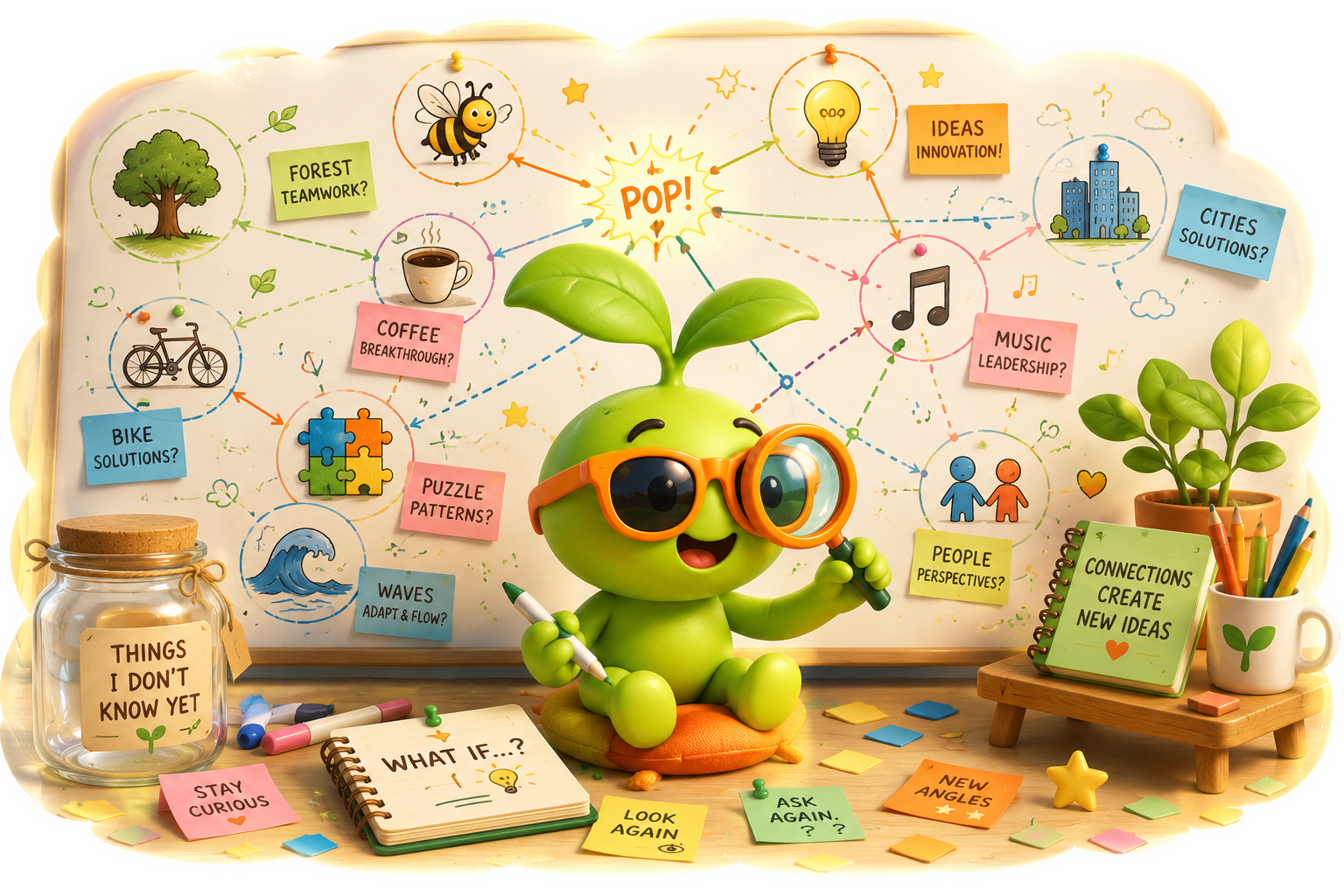
Every so often, a HappiU Experience will ask you to do something slightly unexpected for a busy adult with a perfectly good phone in their pocket:
draw something, cut something out, write it by hand, arrange it, colour it, build it.
This is not arts and crafts class.
And you definitely don't need to be “creative”.
So why do we do it?
A few reasons. Some practical. One rather less so. 😎
1. Making something slows the moment down
A thought can pass through your head in a second.
Choosing a colour, drawing something, folding a piece of paper or deciding where something belongs takes a little longer.
That extra time isn't wasted.
Sometimes making something simply gives you a little more time to stay with what you've noticed before moving on to the next thing.
2. What you make can stick around
A note in an app disappears when you close it.
A strange little thing you made may still be sitting on your desk tomorrow morning while you make coffee. 😂
Most HappiU Experiences are deliberately short.
Sometimes the things you make give part of the Experience a small life after the Experience itself is over.
3. It gets you off the screen
HappiU opens a door and then lets you leave.
The digital space gives you the invitation.
The Experience itself happens in your actual life.
Sometimes with other people.
Sometimes outside.
Sometimes with a pencil, a pair of scissors or your actual hands.
Your screen isn't the destination.
It's the doorway. 🌱
4. Grown-ups are allowed to play too
Somewhere along the way, grown-ups become rather good at doing things for a reason.
We organise.
We optimise.
We get things done.
But remember when a piece of paper, a few coloured pencils and a ridiculous idea were enough to keep you busy?
We like borrowing a tiny bit of that childhood curiosity back.
Cut something. Fold it. Draw on it. Make something slightly wonky.
It doesn't have to be productive.
Sometimes making something can simply be part of the fun. 🙃
And no, it doesn't have to look good
There is no artistic requirement anywhere in HappiU.
Nothing is judged. Nothing is uploaded. Nothing is scored.
If drawing genuinely isn't for you, write instead.
If cutting and gluing isn't for you, find another way.
And if none of it appeals today, the Experience still works.
The making is always an invitation, never a requirement. 🌱
🔬 Curious about the research?
A little science underneath 🌱
There isn't one scientific explanation for why HappiU sometimes asks you to make something.
And we're certainly not claiming that folding a piece of paper is a shortcut to happiness. 😂
But several areas of research make this territory interesting.
Studies on drawing and memory suggest that actively producing something can involve semantic, visual and motor processes together, and that drawing information can sometimes make it more memorable than simply writing it down.
Research on arts and crafting also offers an interesting, although still developing, picture.
A large observational study of 7,182 adults in England found that participation in creating arts and crafting was associated with aspects of subjective wellbeing, including life satisfaction, happiness and feeling that life is worthwhile.
Because the study was observational, it cannot tell us that crafting caused those differences.
A 2025 systematic review of craft-based interventions found encouraging short-term results across the studies it examined, but also substantial differences in methods, activities and study quality.
The authors concluded that more high-quality research is needed before strong claims can be made about the effects of crafting or the mechanisms behind them.
So our reason for making things at HappiU is deliberately modest:
sometimes doing something with an idea can create a different experience from simply reading about it.
And sometimes...
it's just fun to make the thing. ✂️🌱
Research behind this idea
Wammes, J. D., Meade, M. E., & Fernandes, M. A. (2016).
The drawing effect: Evidence for reliable and robust memory benefits in free recall.
The Quarterly Journal of Experimental Psychology, 69(9), 1752–1776.
DOI: 10.1080/17470218.2015.1094494
Across seven experiments, drawing information produced stronger recall than simply writing it. The authors proposed that drawing can create a richer memory representation by integrating semantic, visual and motor processes.
Wammes, J. D., Jonker, T. R., & Fernandes, M. A. (2019).
Drawing improves memory: The importance of multimodal encoding context.
Cognition, 191, 103955.
DOI: 10.1016/j.cognition.2019.04.024
This research explored components involved in the drawing effect and provides further evidence that drawing can benefit memory through a combination of processes involved in actively producing the information.
Keyes, H., Gradidge, S., Forwood, S. E., et al. (2024).
Creating arts and crafting positively predicts subjective wellbeing.
Frontiers in Public Health, 12, 1417997.
DOI: 10.3389/fpubh.2024.1417997
Using data from 7,182 adults in England, this observational study found that participation in creating arts and crafting was associated with aspects of subjective wellbeing, including life satisfaction, happiness and feeling that life is worthwhile. Because the study was observational, it does not establish that arts and crafting caused these differences.
Bukhave, E. B., Creek, J., Linstad, A. K., & Frandsen, T. F. (2025).
The effects of crafts-based interventions on mental health and well-being: A systematic review.
Australian Occupational Therapy Journal, 72(1), e70001.
DOI: 10.1111/1440-1630.70001
This systematic review examined 19 studies of craft-based interventions and found encouraging results across a range of outcomes. However, the studies varied substantially in design, craft activity and methodological quality. The authors therefore concluded that stronger research is needed before firm conclusions can be drawn about the effects and mechanisms of craft-based interventions.